Showing posts with label Luther. Show all posts

Wednesday, November 8, 2017

The Height of Absurdity: The Vatican Commemorates 500 Years of the Lutheran Heresy with a Postage Stamp

  • THEY CELEBRATE AND HONOR A REPROBATE THAT CAUSED SO MANY TO ABANDON AND BETRAY THEIR CATHOLIC FAITH.
  • THEY PLACE HIM ALONG WITH CHRIST CRUCIFIED USURPING THE PLACE OF THE MOTHER OF GOD.
  • BEHIND THE SCENE, THE CITY OF WITTENBERG IS OBSERVED WHERE HIS REBELLION BEGAN AGAINST THE CHURCH FOUNDED BY CHRIST.


Sunday, October 29, 2017

Luther Lost His Faith Because of His Heresies


Saint Thomas Aquinas teaches:

“A heretic who disbelieves even one article of faith does not have faith, either formed or unformed. The reason of this is that the species of every habit depends on the formal aspect of the object, without which the species of the habit cannot remain. Now the formal object of faith is the First Truth, as manifested in Sacred Scripture and the teaching of the Church. Consequently, whoever does not adhere, as to an infallible and Divine rule, to the teaching of the Church, which proceeds from the First Truth manifested in Sacred Scripture, has not the habit of faith, but holds the other articles of faith by a mode other than faith. Like someone who holds in his mind a conclusion without knowing how that conclusion is demonstrated; it is evident that he does not have scientific knowledge, but merely an opinion about it.

"So likewise, it is evident that he who adheres to the teachings of the Church, as to an infallible rule, assents to whatever the Church teaches; otherwise, if, of the things taught by the Church, he holds what he chooses to hold, and rejects what he chooses to reject, he no longer adheres to the teachings of the Church as to an infallible rule, but to his own will. Hence it is evident that a heretic who obstinately disbelieves even one article of faith, is not prepared to follow the teaching of the Church in all things (but if he is not obstinate, he is not a heretic but only erring). Therefore, it is clear that such a heretic with regard to one article has no faith in the other articles, but only a kind of opinion in accordance with his own will."


Friday, October 13, 2017

Luther, the Great Heretic

Lutero, gran hereje

Luther, the Great Heretic

The thesis that stated that the moral decadence of the Church under the Renaissance Popes had reached an intolerable extreme, and that Luther led the Protestants against this situation, demanding a "reform", is false and no current historian is capable of holding it.
  

Next 31 October will mark a new anniversary of the 95 theses nailed, in 1517, by Luther to the door of the church of the Wittenburg palace. There are several recent publications on Luther, in which he is shown as a Bible enthusiast, as its propagator and as a reformer of a Roman Church corrupted in its time, etc. It therefore seems appropriate to make some clarifications.

He was not a reformer of manners, but of doctrines.- The thesis that states that the moral decadence of the Church under the Renaissance Popes had reached an intolerable extreme, and that Luther led the Protestants against this situation, demanding a "reform " is false and no current historian is capable of holding it. Among other reasons, because Luther himself dismisses this interpretation of his work in numerous explicit statements. "I do not dispute bad customs, but impious doctrines." And years later he insists on this: "I did not challenge immoralities and abuses, but the substance and doctrine of the Papacy." "Among us," he confessed openly, "life is rotten, as it is among the Papists; but we do not accuse them of immorality ", but of doctrinal errors. Indeed, "bellum est Luthero cum prava doctrina, cum impiis dogmatis" (Melanchton).

Reformer of the Catholic doctrine.- Luther, in fact, fought with all his forces against the doctrine of the Catholic Church. To begin with, he destroyed the Bible, by leaving it at the mercy of free examination, he changed the infallible and unique Divine Word for an innumerable and contradictory variety of fallible human words. He destroyed the Apostolic succession, the ministerial priesthood, the bishops and priests, the doctrine of the Fathers and Councils. He eliminated the Eucharist, as a sacrifice of redemption. He destroyed the devotion and worship of the Blessed Virgin and the saints, the vows and religious life, the charitable function of ecclesiastical law. He transformed the seven sacraments into one and a half. He affirmed, on the basis of the total corruption of man by original sin, that "reason is the devil's great whore, a whore eaten away by mange and leprosy" (etc., and five more lines). And for the same reason, and with equal passion, he denied the freedom of man (1525, De servo arbitrio), stating that "the most certain and religious" thing would be that the very term "free will" disappeared from the language. As a logical consequence, he also denied the need for good works for salvation. In short, with its "correct answers", as an author today writes, he practically destroyed all Christianity, destroying Christendom in passing.

Schizoid thinking.- The Catholic Church links reason with faith, understanding theology as "ratio fide illustrata" (Vatican I). It links the Bible with Tradition and the apostolic Magisterium (Vatican II, Dei Verbum 10). It links grace with the free action of the human will. Et et.

Luther's thought, on the other hand, is schizoid: Vel vel. Considering that "reason is the devil's great whore," he concludes: sola fides. Convinced that the mind and conscience of the Christian man are above the Fathers, the Popes and the Councils, he dictates: sola Scriptura. Affirming that man is not free, and that good works for salvation are not necessary, he declares: sole gratia.

The greatest offender of the Kingdom.- Luther writes that "the entire Church of the Pope is a Church of whores and hermaphrodites," and that the pope himself is "a furious madman, a forger of history, a liar, a blasphemer," a pig, a donkey, etc., and that all papal acts are "sealed with the devil's shit, and written with the farts of the donkey-pope." Countless pages could be filled with similar or worse phrases.

The Catholic theologians of Luther's time rejected his theses, earning from him the foreseeable qualifiers. The Faculty of Paris was "the condemned synagogue of the devil, the most abominable intellectual whore who has lived under the sun." And the theologians of Leuven, for their part, were "gross asses, cursed pigs, epicurean pigs, heretics and idolaters, damn broth of hell." It is not surprising that, thinking thus, Luther rejected Charles V's proposition in Worms to discuss his doctrines with the most prestigious Catholic theologians. Who can be interested in discussing with demon-possessed pigs?

In addition, Luther's insults had a universal extension: German women, for example, were "shameless slanders"; the peasants and bourgeois, "drunkards, given to all vices"; and of the students he said "there were scarcely one or two in a thousand he could recommend."

The perfect heretic.- "I, Dr. Luther, unworthy evangelist of our Lord Jesus Christ, assure you that neither the Roman Emperor [...] nor the pope, cardinals, bishops, saints, princes or knights will have anything against these articles, in spite of the whole world and all the devils [...] I am the one who affirms it, I, Dr. Martin Luther, speaking in the name of the Holy Spirit ». "I do not admit that my doctrine can be judged by anybody, not even the angels. Whoever does not listen to my doctrine cannot be saved."

Rough with the poor, weak with the powerful.- On the occasion of the uprising of the peasants, who demanded, first nicely and then not so much, what they considered their rights, writes Luther a harsh invective against the rapacious and homicide hordes of the peasants (1525). "The seditious must be thrown down, strangled and killed privately or publicly, for nothing is more poisonous, harmful and diabolical than a promoter of seditions, just as one must kill a rabid dog, because if you do not kill it, it will end with you and with all the country."

Luther, however, was very gentle with the powerful German princes, in order to win their favor. When, for example, Philip of Hessen, a great landgrave, married to Catherine, with whom he had seven children, demanded the approval of an additional marriage with a lady of the Saxon nobility, he obtained both Luther and Melanchton’s license, provided that it was kept secret. In this case of polygamy, consumed in 1540, they relied on the ancient Jewish Patriarchs.

Frightened of his own work.- The results of Luther's preaching were devastating in the morality of the people, and he himself recognized it. "Since the tyranny of the pope has ended for us, everyone despises pure and healthy doctrine. We no longer have the appearance of men, but of real brutes, a beastly species”. Of his followers he affirmed that "they are seven times worse than before. After preaching our doctrine, men gave themselves up to robbery, sham, drunkenness, and all manner of vices. We cast out a demon [the papacy] and there came seven worse."

Terrified, he wrote to Zwingli: "It is frightening to see how where at one time everything was tranquility and peace prevailed, now there are all kinds of sects and factions: an abomination that inspires pity [...] I am forced to confess it: my doctrine has produced many scandals. Yes; I cannot deny it; these things often terrify me. "And he still foresaw major disasters. One day he confided to his friend Melanchton: "How many different teachers will emerge in the next century? The confusion will come to an end”.

That's how it went. And so it has been in accelerated progression, until the great current apostasy of the old Catholic nations.

José María Iraburu, priest
Source: Infocatólica

Wednesday, February 8, 2017

Video: The Devotion to the Immaculate Heart of Mary and Other Fundamental Issues in the Church: By Bishop Athanasius Schneider


Since he was in Mexico, the lecture given by Bishop Schneider is in Spanish, but after minute 42.3 there is a series of different and interesting questions made by the people which the Bishop answered in English.

During his stay in Mexico, Archbishop Athanasius Schneider gave the following lecture on the importance of the devotion to the Immaculate Heart of Mary in these times of unequaled apostasy in the history of the Church. This devotion is a final and decisive remedy that the Blessed Virgin gave us to solve the current crisis of the Church and the world. At the end of his dissertation on this necessary devotion, he answered to various questions from the audience.

Among them he referred to the right provided by the Church to every Catholic to receive Communion on their knees, and pointed out that any priest who denies Holy communion to the kneeling faithful commits a grave abuse of arrogant clericalism and a sin of discrimination against the faithful who so request.

As for the request of the Blessed Virgin in Fatima for the Roman Pontiff to consecrate Russia to her Immaculate Heart together with all the bishops of the world, he said that "it could be done again in a more solemn, more explicit and more perfect way." We remind our readers that Pius XII did not do it with all the bishops of the world, and John Paul II did not explicitly mention Russia (but only implicitly when consecrating the whole world) nor did all the bishops of the world participate.

About Amoris Laetitia, the Pastoral Exhortation of Pope Francis, which has been interpreted by the Argentine bishops as an authorization for divorced people living in a new union to receive Communion in spite of living in adultery (endorsed by Francis himself, which constitutes a scandal), Bishop Schneider amply referred to it; pointing out the different and contradictory interpretations made by several bishops and episcopates (some in favor of the doctrine taught by Christ and the Sacred Scripture and others in favor of sacrilegious permission). He explained in detail the true doctrine of the Church in this regard.

Regarding the celebration of the 500th anniversary of Luther's so-called "Reformation", and the description that the Pontifical Council for the Promotion of Christian Unity made about the heresiarch calling him a "witness of the gospel," he made an extensive dissertation to explain why "we would have to deny all our faith" if we say that he indeed was a witness of the gospel. He recalled that the pope is not infallible in his daily acts (Editor’s Note: Only in certain conditions the gift of papal infallibility applies) and that "there have been popes who have performed acts that were not the best thing for the Church". And he exhorted the people to pray for the present Pontiff, because God has granted and grants great graces through prayers, sacrifices, sufferings and the intercession of the little faithful of the Church.

He pointed out that after the Second Vatican Council a spring was waited, and in fact a painful autumn came. And that this is evident and one would have to be blind not to see it.

Finally, he expressed his desire and exhorted us to remain Catholics in the full and integral sense of the Catholic word.

The event ended with a consecration to the Immaculate Heart of Mary, which all our readers can make when listening to this video.

It is important to note that to give this lecture within the Temple, the Blessed Sacrament was reserved in the sacristy so that it would not be in the church's tabernacle during it.


Monday, January 23, 2017

Protestantization in the Church

"I also saw worldly and Protestant ecclesiastics in Germany expressing wishes and forming plans for the fusion of religions and for the suppression of papal authority.
And this plan had its promoters among the prelates in Rome! "(AA.III.179)
Visions and Revelations of Ana Catalina Emmerich.


PROTESTANTIZATION IN THE CHURCH

The following are eleven of the steps that have been taken in the process of Protestantization of the Church. They are not the only ones, but some of the most important ones. Naturally, according to the promise of Christ, there will always be a healthy part of the Church that will remain true and completely Catholic and will reject the protestantization that they seek to impose. Everything indicates that the general apostasy announced in the Holy Scripture is in a very advanced process. Notwithstanding all this, we know by faith that eventually the Church will triumph.

1.- Six Protestant pastors were allowed to collaborate with Archbishop Anibal Bugnini (later accused of being a Mason and exiled as a diplomat pro-nuncio in Iran for the same reason) in the elaboration of the new rite of Mass (imposed in 1969) from which it was suppressed the Catholic theology which bothered the so-called "separated brothers”, and a new rite was created which, according to Cardinal Bacci and Cardinal Ottaviani (Prefect of the Congregation for the Doctrine of the Faith), "departs dramatically as a whole and in detail from the Catholic theology of the Holy Mass as formulated by the 20th session of the Council of Trent which, by fixing the ‘canons’ of the rite, raised an insurmountable barrier against any heresy that could infringe upon the integrity of the Mystery.”
2. After this, several Protestant pastors declared to be able to "celebrate" their Dinner with the same rite of the new Mass as the theological obstacles that this secular rite (the traditional Mass) presented against their heresies had disappeared. Bishop Bugnini acknowledges that the liturgical reform was carried out with an "ecumenical" intention to please Protestants.
3.- From November 1969 onwards it was prohibited (against all Law, since it was never abolished) IN THE PRACTICE the celebration of the Traditional Mass with people, and those who celebrate it are persecuted, harassed and / or punished.
4. In the last decades, in contravention of the traditional doctrine as well as the dispositions of Pius XI (encyclical Mortalium Animos), multiple ecumenical acts, like those made in Assisi, have been carried out.
5. – It was spread in the Church the extremely serious mistake that the Protestant sects are also ways of salvation and that they make up (together with the Orthodox and Catholics) the Church of Christ, thus ignoring the dogmatic truth (which was always preached by the Church) that indicates that the only Church of Christ is the Catholic Church and this is the only true way of salvation.
6.- Until 2007, after three pontificates, Benedict XVI recognized that the traditional rite of the Mass was never abolished and that any priest has the right to use it. Nevertheless, many bishops - contrary to all Law - continue to avoid it in their dioceses and excluding those who attempt to celebrate it.
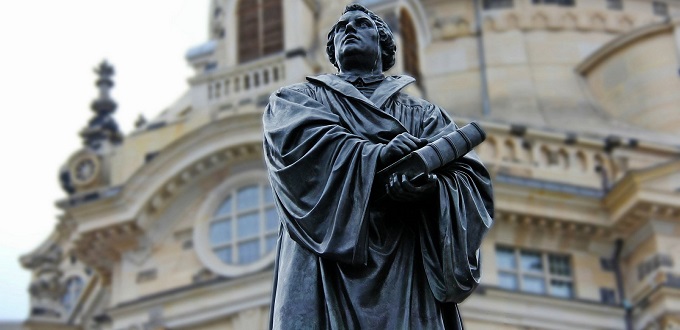
7. In October 2016, a statue of Luther presided over the papal audience. There a group of Protestants delivered a luxurious book with the theses of Luther to Pope Francis who received it smiling and gratefully.
8.- Days later, Pope Francis went to Sweden to pay homage to Luther and to commemorate - with the Lutherans - the (badly called) Protestant Reformation. He refers to the blasphemous heresiarch with these words in the Lutheran cathedral of Lund: "Luther found that merciful God in the Good News of Jesus Christ" (31-X-16). There he signed a Declaration that says: "We are deeply grateful for the spiritual and theological gifts received through the (Lutheran) Reformation."
9. On the eve of the feast of the Epiphany of the Lord, the Pontifical Council for the Union of Christians issued a document on the new relations between Catholics and Lutherans. There we learned that "Separating what is controversial from the good things of the Reformation, Catholics are now able to lend their ears to Luther's challenges to today’s Church, recognizing him as a “witness of the gospel.”
10. In January 2017, Francis stated that, according to him, the intention of Martin Luther, five hundred years ago, "was to renew the Church, not to divide it" and that "at the same time we have alive in our hearts the sincere repentance [Sic] for our sins [Sic]”. And he congratulated Cardinal Kurt Koch (see video below), president of the Pontifical Council for Promoting Christian Unity, for his article in L'Osservatore Romano, where he noted: "(Luther) had in mind the renewal of the whole Christianity in the spirit of the Gospel ... in the Second Vatican Council, Martin Luther would have ‘found his own council’”. In 2012, when Koch still spoke as a Catholic, said that the Church would not celebrate Luther's schism in 2017 because the Church "cannot celebrate a sin."
11.- The Holy See announced that it will create a postal stamp with the figure of the heresiarch to commemorate the 500 years of his schism (which it improperly calls "Reformation"). Surely we will see acceleration of this process of protestantization in 2017, on the occasion of this "commemoration." It is rumored that if the door to sacrilege has already been opened so that - in certain cases - the divorced living in an adulterous union can receive Communion, the same door will also be opened to Protestants without having to convert.

There is much talk of "mercy", but sanctions and threats have already begun for those who oppose sacrilege and the protestantization of the Church. In fact, giving Communion to the divorced living in a new union is a significant step in that direction and an endorsement of Protestant customs. Thus, on January 16, the bishop of Pereira, Colombia, Rigoberto Corredor, suspended priest Luis Carlos Uribe Medina a divinis for rejecting the heterodox pastoral care derived from "Amoris Laetitia" (exhortation whose theses were already written 10 years ago by the Argentine priest Víctor Manuel Fernández, good friend of the then cardinal Bergoglio and that were transcribed after two useless and onerous synods, being that the theses were already predetermined). On the other hand, Bishop Mario Grech of the Diocese of Gozo, Malta, is saying that he will strip all priests of their priestly faculties if they do not follow their new guidelines (which state that: "If ... a separated or divorced person who is living in a new relationship can ... recognize and believe that he or she is at peace with God, cannot be excluded from participation in the sacraments of Confession and Eucharist"), which contradict the dogmatic and immutable doctrine of the Church and the immovable discipline intimately derived from it, established in Canon 915 of the Code of Canon Law, which orders that "those who obstinately persist in a manifest grave sin should not be admitted to Holy Communion." This judgment is based on the objective situation of the couple, called external jurisdiction, and is completely independent of their subjective feeling of guilt, which is part of what is called the internal jurisdiction.

As can be seen, persecution and invalid canonical sanctions are intended to be applied again, as when the same process was unjustly carried out with those who defended the traditional Mass and persevered in celebrating a rite that remained in force (decreed in perpetuity by Saint Pius V), as many years later Benedict XVI would recognize.

The process of protestantization is progressively accelerating, in fact in the Congregation for the Doctrine of the Faith and in the Congregation for Divine Worship and the Discipline of the Sacraments, even though they retain their holders, they have made redundant – (on 2016) those elements that were opposed to this process. The same happened with Cardinal Burke for objecting in the synods that the Eucharist was sacrilegiously bestowed upon the divorced living in new unions. For this reason he was discharged as Prefect of the Supreme Court of the Apostolic Signatura and banished from Rome as patron of the Sovereign Order of Malta to which the Holy See also threatened as they did with the Franciscans of the Immaculate who had become "too" traditional.

Everything points to the beginning of the great apostasy. Those who realize this thank God and ask Him for the grace to remain faithful until the end, for during this process the number of deserters will be large and, abhorring what they believed, they will even imagine doing so in the name of God. Many of the faithful and clerics have already become modernists and have protestantized themselves (to a greater or lesser degree) without even noticing it, for when someone has been living for a long time in the midst of bad smells, stops noticing them. That process will be gradual and inadvertent , like that of the frog that dies boiled because the water in which it is in, heats gradually. Scripture prophesies that this apostasy will be universal. That is, only a few will keep faith and fidelity to the Catholic Church. It will be a true grace of God and an effect of their prayers and of their strong and good will, for they must overcome a thousand temptations (among them: social pressure, intellectual pride, self-judgment, rebellion to God under the pretext of obedience to authority - which is the master blow of Satan - fatigue in the struggle, etc.) that the Evil One will put in front of them to divert them. Let us be alert and pray much to preserve that whole faith and to defend catholicity.

Let us always keep in mind Saint Paul's warning: "But if we ourselves or an angel from heaven preached to you a gospel contrary to that which we have preached to you, let him be ANATHEMA" Galatians 1: 8.

Come, Lord Jesus.


Video (click here):


COMMENT TO THE VIDEO:
The Truth and the error are not in parity to "rediscover" anything. The Catholic Church has the whole of the Gospel; it is heresy that must cease in order to truly come to Christ and discover Him in His entirety. Not making heretics see this is gravely contrary to the charity that must watch over the salvation of their souls. The mission of the Church is to save souls and to make them see with charity the wrongs of their mistakes and to preach to them the immutable Truth that has as a divine deposit, attracting them to the true and unique Church of Christ: the Catholic founded by Our Lord Jesus Christ on the rock of Peter. The order of Christ was, "Go into all the world, and preach the gospel to ALL CREATURES: He that believeth and is baptized shall be saved: but he that believeth not shall be damned." (Mark 16: 15-16). But now, contrary to this, in the name of false ecumenism it is said that all proselytism is outlawed.

Monday, December 26, 2016

Luther, Corrupter of Law and Politics


Column of Juan Manuel de Prada for ABC (Spain), November 5, 2016

The Truth About Luther

Five hundred years after Luther's protest, we can become Swedish to gain the applause of the world, or else we may dare to analyze with intellectual rigor what that event has substantiated. This second attitude, which is a cause of scandal in a world where becoming Swedish is something cool, is the one that it’s offered to us in an excellent book called "Political and Legal Consequences of Protestantism” written under the supervision of Professor Miguel Ayuso, in which a select group of jurists provide the conscious reader with a series of approximations to the thought of Luther and point out the political flaws that come from him. Celebrating the centennial of the Lutheran protest is as if someone with syphilis celebrated the day he contracted the disease.

It would be necessary to begin by pointing out, as Professor Juan Fernando Segovia does in one of the most important contributions of the book, that in affirming salvation by faith alone Luther denies all authority to the Church, as well as its mediating role between the believer and God and the efficacy of the sacraments. The Church, for Luther, is an oppressive organization; and the Papacy, the seat of the Antichrist. But the book we recommend today is valuable above all because it reveals how Luther's obscure theological notions (depravity of human nature, denial of free will, etc.) corrupt and destroy political and social institutions. If man is evil by nature and his reason is corrupted, power will have to be erected in pure exercise of force that represses its evil tendencies. Thus, before the peasant revolt of 1525, Luther can celebrate that "the avenging sword" rises against the princes; and when the peasants are defeated, he can petition the princes: "Persecute them and kill them like rabid dogs. God will reward you.” For a civil power understood in the Lutheran way can change of titular as of jacket. On the other hand, as Joseph Luis Widow reminds us in another passage of the book, having established the deranged premise that human nature is completely corrupted, Luther logically thinks that reason is "blind, deaf, foolish, impious and sacrilegious"; in such a way that it is not capable of wanting good, and it is incapacitated for moral judgment. Justification by faith alone leads inevitably to the emancipation of moral judgment consciousness over our actions; and thus pure subjectivism is enthroned, until the natural tendency to disorder requires the intervention of a human law that imposes itself as an exercise of power. But, as Professor Segovia points out, in affirming the absolute corruption of human nature, Luther denies the value of the law: for by ordering to do this or that work, the law (in Luther's words) only "reveals the disease, the sin, the wickedness" of man, who inevitably is "assaulted by sadness, feels afflicted, and even falls into despair." That is, in fact, the last station of man conceived in the Lutheran way.

In "Political and Legal Consequences of Protestantism," other calamities originate in Luther's thought, such as the reduction of the political to the state, nationalism, unbound capitalism, or the establishment of a freedom which is not guided by reason, but by a "self-determination" whose only limit is not to harm third parties (a limit that, of course, is ultimately infringed, when such damage benefits the owner of power). And in this way unveiling the truth about Luther that others prefer to ignore by becoming Swedish.

Monday, November 28, 2016

The Death of Luther


How did Luther Die?

The official Protestant version narrates that the greatest architect of the Christian rupture died of a natural death on February 15, 1546, after a trip to Eisleben and suffering from angina pectoris; Was it really like this?

A contemporary German scholar, Dietrich Emme, offers a very different version in a review of events. In his book "Martin Luther, Seine Jugend und Studienzeit 1483-1505. Eine dokumentarische Darstelleng "[1] ("Martin Luther: Youth and Years of Study from 1483 to 1505. Bonn 1983") points out that Luther committed suicide, and he is not alone in pointing this out.

Likewise, a Freudian psychoanalyst, M. Roland Dalbiez, in his study Luther's Anguish [2], attributes him "... a very serious neurosis of anguish, so grave that one may wonder whether it has not been due to a border-state between neurosis on the one hand and “suicide raptus” on the other, a teleological anti-suicidal automatism"[3].

Indeed, Luther had suicidal tendencies, as it can be corroborated in his own "Tischreden" ("Table Talk"), where one of his conversations with Pastor Güben Leonhard Beyer, in 1551 is documented:

"He told us that when he was a prisoner the devil had wickedly tormented him and that he had laughed heartily when he (Luther) took a knife in his hand, saying:" Go ahead! Kill yourself! "(...). This has happened to me very often, so much as to put a knife in my hand ... and what evil thoughts came to mind in this way, so evil that I could no longer pray "[4].

In 1606, Franciscan Heinrich Sedulius in his "Preaescriptiones adversus haereses", narrates something analogous bringing up the valuable testimony of Ambrosio Kudtfeld, a witness and man of confidence of the "reformer" who, far from accounting a death from angina , says:

"On the night before his death, Martin Luther let himself be overcome by his habitual intemperance and in such excess that we were obliged to take him, completely drunk, and place him in his bed. Then, we retired to our bedroom, without sensing anything unpleasant! The next morning, we went back to our lord to help him get dressed, as usual. Then - oh, what a pain! - we saw our master Martin hanging from the bed and strangled miserably! His mouth was crooked, th right part of his face was black, his neck was red and deformed."[5]

Indeed, at that time raised beds supported by columns were used.

"In the face of this horrible spectacle, we felt great fear! We ran, without delay, to the princes, his guests of the day before, to announce to them the execrable end of Luther! They, full of terror like us, immediately promised us, with a thousand promises and the most solemn oaths, to observe, with respect to that event, an eternal silence. Then they ordered us to remove the rope from Luther's hideous corpse, lay him on his bed, and then report to the people that "Master Luther" had suddenly abandoned this life!"[6]

Maritain himself points out that Dr. De Coster, who examined Luther, explained that the deceased's mouth was crooked with the face black and the neck red and deformed [7].

Likewise, Oratorian priest Bozio, in his book "De Signis Ecclesiae", published in 1592 [8], points out that one of the reformer's household indicated that his lord was found hanged from the columns of his bed; Dr. Géorges Claudin says the same: [9].

As Villa points out, "Luther, then, did not die a natural death, as has been falsely written in all the history books of Protestantism, but died as a suicidal, hanged from his bed after a splendid dinner,  in which, as usual, he had drunk too much and was satisfied with food beyond all bounds!"[10].

Paradoxically, that February 15, 1546, feast of the Chair of St. Peter, he, who had railed against the Church, the Papacy, and the Catholic doctrine, voluntarily abandoned his mortal life at three in the morning, the anti-hour of Redemption that Our Lord Jesus Christ brought to us on Calvary.

It's sad: but that's the end of those who live in a bad way.

Don’t let them deceive you…

P. Javier Olivera Ravasi

SOURCETranslated from Spanish by Catholicity blog.

1] It is worth saying that the two most competent historians in Germany on Luther’s life: Dr. Theobald Beer and Prof. Remigius Baumer, have corroborated both the material and the documents cited by Emme.
[2] Roland Dalbiez, L’angoisse de Luther, Tequi, Paris 1974.
[3] Luigi Villa, Martin Lutero, Homicidal and Suicidal, Civilta, Brescia s/f, 5 (http://www.chiesaviva.com/lutero%20omicida%20e%20suicida/lutero%20homicida%20y%20suicida.pdf),
[4] Luigi Villa, op. cit., 12 13.
[5] Ibídem, 16. The text in Latin can be seen in Heinrici Seduli ex Ordine Minorum, Praescriptiones adversus haereses, Officina Plantiniana, Antwerp 1606, 257 pp. (online version here: http://bajarlibros.co/libro/f.-heinrici-seduli-ex-ordine-minorum-praescriptiones-adversus-haereses/bwjIJTfTtzjt2o2G/)
[6] Ibídem.  An interesting coincidence is that Maritain narrates in his book “Three Reformers” that several friends, companions and first disciples of Luther also committed suicide.
[7] Maritain’s information is contained in the French edition, not the Spanish one.
[8] Tomás Bozio, De signis Ecclesiae, Pedro Landry, Lyon 1593-1594, 3 vols.
[9] Géorges Claudin, La mort de Luther, Noisy-Le-Sec, Paris 1900, 99 ( http://gallica.bnf.fr/ark:/12148/bpt6k9323938.r).
[10] Luigi Villa, op. Cit., 17.

Friday, November 11, 2016

The Church Infallibly Condemned Martin Luther: Bishop Athanasius Schneider

“To put on the same level the religion of divine origin and the religions invented by men is the blasphemy which calls down chastisement on society far more than the sins of individuals and families.”
Désiré Felicien Francois Joseph Cardinal Mercier (1851-1926).


Are the blasphemies of Luther spiritual gifts? His heresies against the Divine Revelation are theological gifts? Did Luther find God while being an apostate of the true Church? Why does Pope Francis contradicts everything that the Church has infallibly taught us about the errors of this heresiarch? Why does he celebrate the anniversary of Luther’s rebellion in a Lutheran temple with false “bishops” and “women bishops” who are supportive of homosexuality, and who are the most distant from the Gospel, the most liberal and the least representative of Lutheranism, because they are rejected by all the other Lutherans who are less liberal?

Padre Pio also claimed that Luther had been condemned, how is it possible then to celebrate what they called the “Reform”, which really was a whole deformation of the Catholic doctrine carried out by the heresiarch whose errors, as Bishop Schneider points out, were condemned ex cathedra by the Church, that is, infallibly and irrevocably?

Saturday, October 29, 2016

Should We Pay Tribute to a Reprobate?


Luther did not seek to reform the Church – divinely founded – but to destroy it through the creation of his human establishment made according to his liking and convenience. He was not a reformer but a deformer.

If we celebrate Luther’s rebellion against the Church of Christ and the revealed doctrine, then following the same logic we should also celebrate the rebellion of Lucifer and its daemons against God.

If Luther, the heresiarch, blasphemed in a thousand ways, as when he said: “the Catholic Mass is the greatest and most horrible abomination of the Popes,” Lucifer shouted: “Non serviam” (I will not serve) talking about God made man.

Both rebellions had in common PRIDE. That is why, according to the vision of Sister Maria Serafina Micheli*, both of them are in Hell. And to celebrate Luther means to pay homage to a reprobate.

*NOTE: (To read click here): Sister Maria Serafina Micheli

Thursday, October 27, 2016

The Blasphemous That Will Soon Be Celebrated in Sweden And Whose Statue Presided Over Pope Francis' Audience

We have transcribed just a few of his outbursts against the Pope and the Church founded by Christ, we have omitted the blasphemies against the Holy Eucharist.


Sources:

1) From Against the Papacy at Rome founded by the Devil, p. 341, Luther's Works, Vol. 41
2) From defense and explanation of all the articles, p. 46, Luther's Works, Vol. 32
3) From Against the Papacy at Rome founded by the Devil, p. 357, Luther's Works, Vol. 41
4) From Against the heavenly prophets, p. 216, Luther's Work, Vol. 40
5) From Explanation of the 95 theses, p. 185, Luther's Works, Vol. 31
6) From Explanation of the 95 theses, p. 204, Luther's Works, Vol. 31
7) From Why did the books of the Pope were burned, p. 393, Luther's Works, Vol. 31
8) From With regard to the ministry, p. 34, Luther's Works, Vol. 40

Thursday, October 20, 2016

Luther Did Not Have Faith


“In a heretic who denies one Article of Faith there is no habit if faith, and this is so because every habit is specified by its formal object, and if this is removed the essence of the habit disappears. But the formal object of faith is the First Truth, inasmuch as it is manifest in Sacred Scripture and in the doctrine of the Church which proceeds from the First Truth. Whoever therefor does not accept, as an infallible and Divine rule, the doctrine of the Church which proceeds from the First Truth, and as it is manifested in Sacred Scripture, such a person has not the habit of faith, and the things which are of faith he accepts from motives other than that of faith. It is like one who assents to a conclusion without knowing or understanding the connection between it and the premises from which it is deduced. This knowledge is not scientific, but merely an opinion.

“So, likewise, it is manifest that he who adheres to the teachings of the Church, as to an infallible rule, assents to whatever the Church teaches; otherwise, if, of the things taught by the Church, he holds what he chooses to hold, and rejects what he chooses to reject, he no longer adheres to the teachings it the Church as to an infallible rule, but to his own will. Hence it is evident that a heretic who obstinately disbelieves even one article of faith, is not prepared to follow the teaching of the Church in all things (but if he is not obstinate, he is not a heretic but only erring). Therefore it is clear that such a heretic with regard to one article has no faith in the other articles, but only a kind of opinion in accordance with his own will.”

Saint Thomas Aquinas

See: Luther in Hell according to the vision of Blessed Maria Serafina. Click here:
http://www.catholicityblog.com/2016/03/false-churches-false-religions.html